
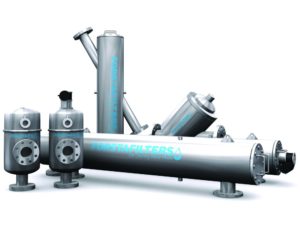
A3-180FRP with 25 micron screen for sea water filtration
Forsta Filters was asked to provide a solution for RO pre-filtration for sea water with high chloride content and high water temperature.
The customer’s idea was to install a self-cleaning water filter to replace the expensive and labor intensive cartridge filters. Forsta automatic backwash filter model A3-180FRP filter is flowing 80-100gpm through 25 micron screen. The filter uses less than 5 gallons of water per 12 second backwash, without disrupting the main flow. This solution saves the customer from spending time and money continuously replacing cartridges.
Filter Characteristics:
- Flow Rate: 15 – 4,500 gpm
- Flush cycle duration: 6 – 20 seconds
- Flush valve size: single 1″ or a single 2″
- Screen opening: 5µ – 4000µ
- Temperature: 150ºF
- Flush Volume: 4 – 50 gallons per backwash
- Working pressure: 35 – 150 psi
In selecting a filter to improve the system’s performance, Presley had to consider the variability of the incoming river water quality, and the price and maintenance required from a new piece of equipment. After reviewing the available technologies and their costs, RG Steel decided on a Forsta Self-Cleaning Screen Filter for the job.
Based on the technical data, Forsta engineers recommended the D8-180 Series model for this application. The fully automatic filter made from stainless steel 304L, was sized with 8″ flanges for the inlet and outlet, designed to operate at pressures from 40-150psi and at a maximum temperature of 210 F. A high porosity stainless steel 316L screen was selected for the filter with 50 micron openings and 9.25sgq ft. of screen area. Two identical D8-180 filters installed in parallel were slated to accommodate the 1200gpm flow at two locations in the mill.
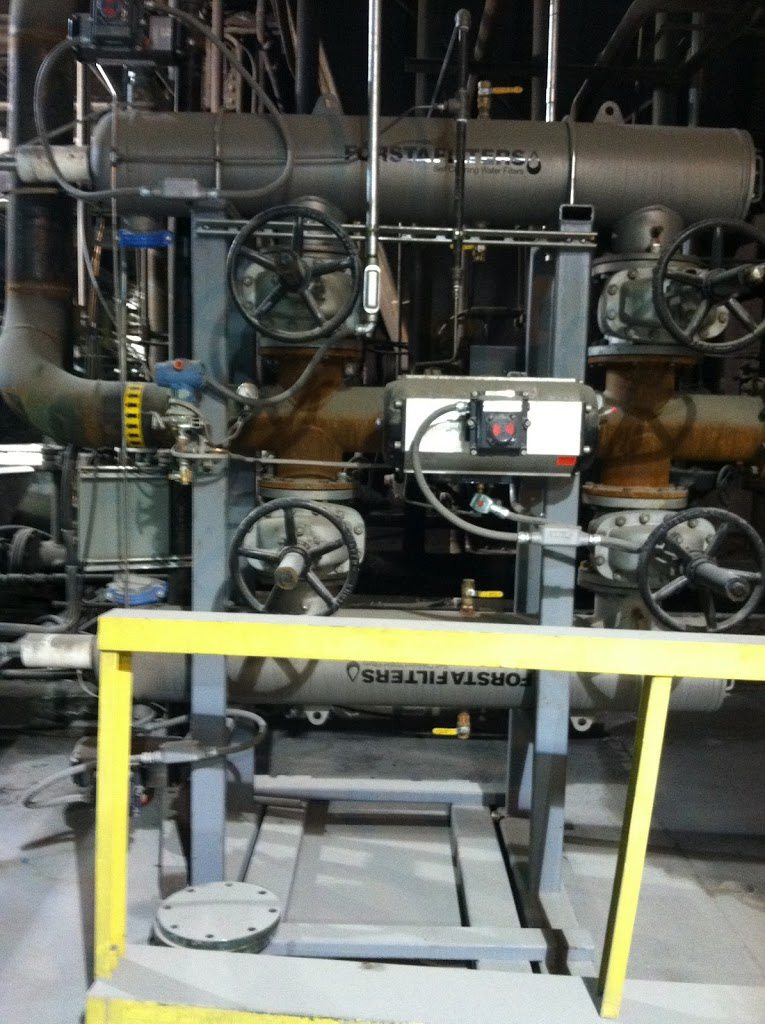 |
| Forsta Industrial self-cleaning water filters in RG Steel Mill |
Forsta Design Engineer Daniel Stenberg commented that, “The significant variable in sizing the filter and selecting a screen for this application, was the quality of the incoming river water. With their 1200micron prescreen, we knew they could still expect to see variability in the inlet water based on the conditions of the river due to weather etc. I wanted to provide RG Steel with a solution that would stand up to the fluctuations in the water quality and not create an environment where the filter became overwhelmed. At the same time, it was important to provide a fine enough screen to provide adequate protection for the spray nozzles – the main reason for adding our filter. Based on the data, a 50 micron screen was chosen for their application.”
Since the filter’s installation, Presley explained that it operates for a 20 minute heat once every hour. During operation he typically sees the filter go through one cleaning cycle. Depending on river conditions, this may vary slightly, but the filter is easily handling the particle load variation. Presley said that the new equipment has prevented spray nozzles from plugging and also has allowed them to better control their emissions unit. They are satisfied with their purchase and would recommend Forsta Self-Cleaning Filters to others with similar applications.
Forsta 180 series self-cleaning water filter animation


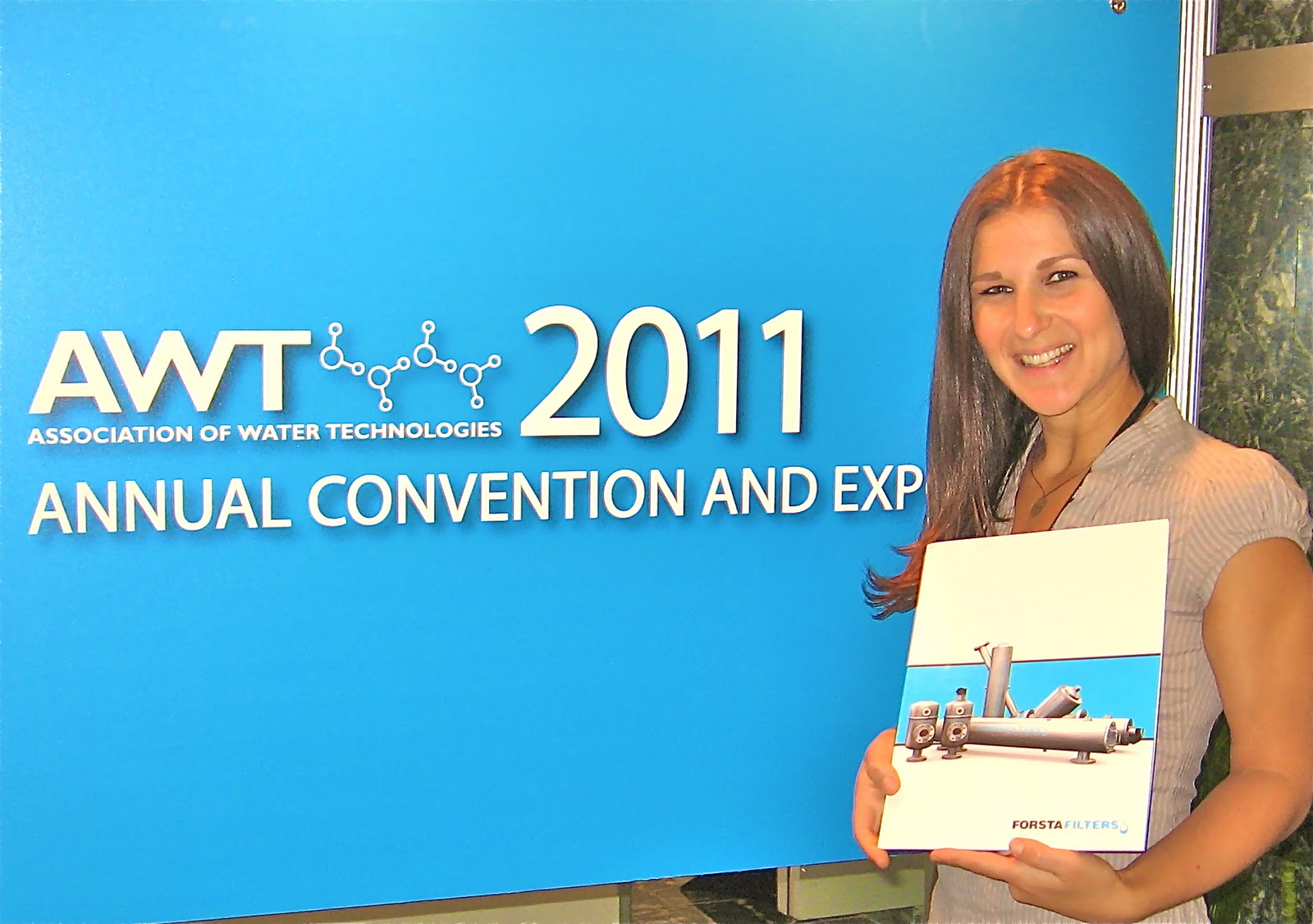 Forsta’s Director of Sales Polly Stenberg said of the conference, “It was exciting to get the word out about Forsta Filters; that the most efficient self-cleaning filter can be a reasonably priced option for suspended particle removal in cooling towers, boilers, heat exchangers, chillers and more.
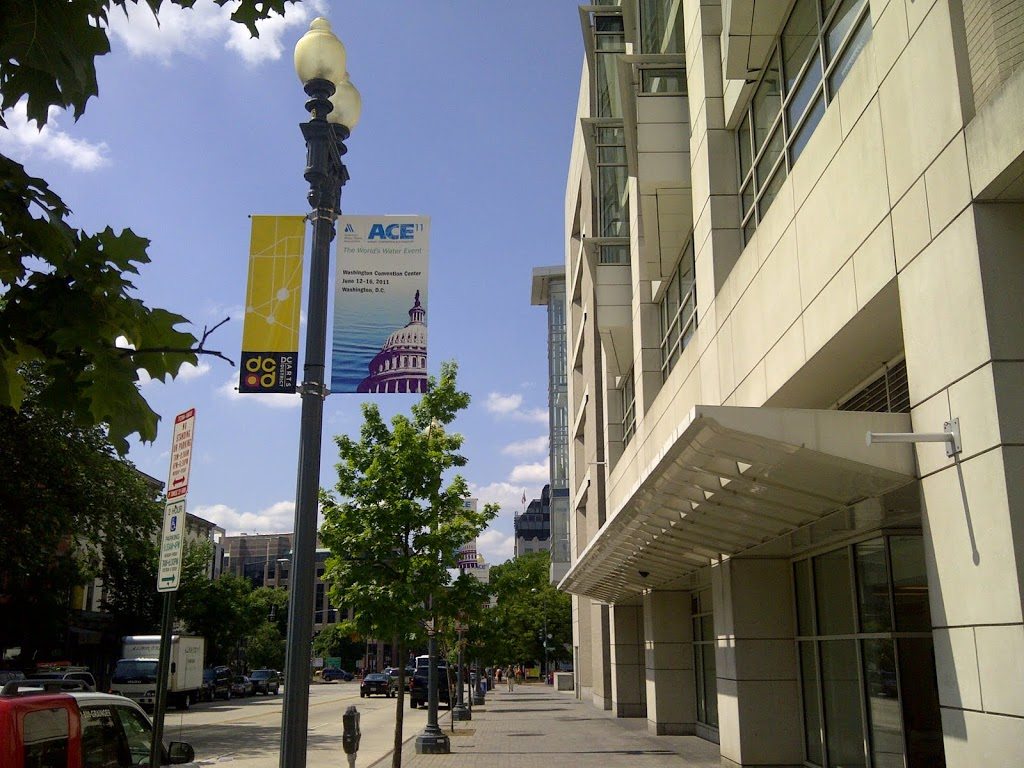

Forsta Filters Attended the 2011 Membrane Technology Conference & Exposition in Long Beach, California and Introduced the FRP Series of Self-Cleaning Filters.

Water Use Efficiency:
Forsta self-cleaning filters have remarkably lower flush volumes than sand filter models. To analyze the water efficiency of a sand filter versus a Forsta self-cleaning filter, one can easily compare performance parameters using the common application of side stream filtration for cooling tower water. Take a sample side stream cooling tower application of 250 gpm. For this application, the average recommended 54 inch sand filter requires approximately 1000 gallons to backwash. For this same application a Forsta Filters D-180 uses only 50-75 gallons.
Backwash Duration and System Flow:
Sand filters require 3-4 minutes for their backwash and cause interruption to the system during that time. Alternatively Forsta self-cleaning filters take only 15 seconds to backwash and will not interrupt the main system flow during the cleaning cycle. Sand filter manufacturers may offer multiple units with a multipart system of isolation valves in an attempt to overcome this problem, however this drastically increases the cost and complexity of the system. Simple design is upheld and extraneous spending avoided by implementing a Forsta self-cleaning filter.
Space Utilization:
Frequently the engineering of a water filtration system must take into consideration a limited amount of space. Forsta self-cleaning filters have less volume consuming configurations than sand filters. For volume comparison, take the same 54 inch sand filter mentioned above. This sand filter takes up 85 ft3 of space whereas the Forsta Filters self-cleaning counterpart flowing the same 250gpm uses only 8ft3 of space. The sand filter requires special platforms, piping and often additional pumps which take up more space and limit the placement of the filter. Forsta self-cleaning filters are designed in a variety of configurations to integrate easily into existing pipelines.
Sand Loss and Degraded Quality:
During the backwash, sand beds rise up and create potential for sand to go out of the backwash pipe.
As a result of the fact that sand essentially hovers during the backwash, it never returns to its original compressed state. Over time sand canals occur and allow particles to pass through. The internal screen element of a Forsta self-cleaning filter delivers a constant and reliable degree of filtration throughout its operation.
Sand Mixture into the System:
Minor damage to a sand filter’s underdrain can easily cause sand from the filter to enter into process water. Sand in the process water may cause unforeseen damage to equipment, prevention of which is the entire reason for installing the filter to begin with. Where this is of concern, sand filter manufacturers recommend installing a basket screen (which requires manual cleaning) as an insurance mechanism. Again, this is a complicated, expensive and maintenance intensive route whereas use of a Forsta self-cleaning filter is straightforward, cost effective, and entirely automatic.
Cost:
Cost examination yields an obvious price advantage of Forsta self-cleaning filters over sand filters for matching flow rates and micron ratings. For example, Forsta self-cleaning models flowing 250 gpm at the 30 micron level cost less than half of the sand filter equivalent.
Forsta Filters, Inc. Engineering Department
Forsta Filters Inc. 2011 All rights reserved
 |
| Self-Cleaning Water Filters by Forsta Filters Inc. |
Forsta self cleaning water filters reduce water use, improve energy efficiency and are made entirely from sustainable materials. Implementing a Forsta Filter in new construction as well as to improve old systems will help projects meet a variety of important environmental and sustainability goals, and where applicable earn LEED certification.
Author of the 2009 Greenbuild Report, Brian Libby explains that water usage and most applications involving water are intertwined with the built environment. “It turns out the vast majority of the water we use [In the United States] goes to cooling power plants. It’s a great example of the connection between water and energy” Libby says quoting Peter Gleick, one of the world’s foremost experts on water resources, and author of the biennial series, The World’s Water.

Forsta self cleaning water filters are ideal for cooling power plants where they control particulate levels, protect heat exchangers, condenser tubes and other water-cooled process equipment. By controlling particulate levels, Forsta’s fully automatic filters will improve operating efficiency, minimize downtime for cleaning and repair, limit the cost of water treatment and improve equipment lifespan.
Compared to other filter technologies Forsta’s self-cleaning water filters are more cost-effective, automatic, produce less wastewater, and will not interrupt a system’s water flow during its short cleaning cycle. Forsta prides itself on sustainability and sets forth a comprehensive social mission to:
Make freshwater more available by reducing, recycling and reusing water in industrial, municipal and irrigation systems. Reduce greenhouse gas emissions by improving energy efficiency. Reduce waste generation and hazardous materials exposure through responsible filtration and effluent treatment.
In 2007 The USGBC published a project profile for the platinum certified building: Sidwell Friends Middle School in Washington D.C. where water management and effective use of filtration took center stage. The profile explained that, “Smart water management is central to the project design… Treated water is eventually reused in the toilets and cooling towers. Students grow vegetables and herbs for the cafeteria on the green roofs, which also sequester rainwater and reduce stormwater runoff. Excess water flows to the courtyard’s pond and rain garden. Filters and swales incorporated into the landscape purify rainwater falling on the site. No potable water is used for irrigation.”
Forsta Filters’ Director of Sales Polly Stenberg is passionate about helping new projects save water and energy, and achieve platinum LEED certification like the Sidwell school. “In many applications, water needs to be filtered from its original source, at least to some extent, in order to be effective. Once water has been used, there is also the considerable question of how to treat and/or reuse polluted wastewater in such a way as to ensure the health of people and the environment. Increasingly, projects have water conservation targets, and conservation experts to help implement new systems.” It is Stenberg’s goal to encourage companies to take advantage of Forsta’s water and energy efficient filters. Forsta is currently offering a Water Stewardship Discount on all projects implementing filters to improve efficiency.